As a personal chef, you’re more than just a cook. You’re a financial manager in a chef’s coat. Your menu is your statement, your income source, and a big challenge all at once.
I’ve been there, staring at a spreadsheet, wondering if that heirloom tomato salad is a masterpiece or a money pit. It’s a delicate balance between creativity and cost. It’s not about pricing dishes like they’re garage sale finds.
Your menu is your heart and your key sales tool. But can it also be a strong point for menu profitability? The answer needs more than just guesses.
This is a strategic dance. You need to make sure that grass-fed beef doesn’t break the bank for your clients. You must figure out the real costs of food, labor, and even where you are.
Forget relying on gut feelings. It’s time to create a profitable menu design that pleases taste buds and keeps your profits safe. It’s like Gordon Ramsay’s intensity meets the curiosity of Freakonomics.
The Relationship Between Menu and Profitability
Your menu is like your business’s silent CFO. It quietly adds to your profits with each sale. Its success or failure can make or break your month.
A menu based on guesses, not data, is shaky. It’s like building a house on Jell-O. Your menu’s profitability is key to your Financial Management. It’s not just about setting prices.
Creating a profitable menu is complex. It involves pricing, standing out, and knowing your costs. Pricing must match what customers are willing to pay. Standing out means using top ingredients and unique methods. And knowing your costs is essential to avoid losing money.
The table below shows the difference between a menu that barely survives and one that thrives.
| Menu Aspect | The Whimsy-Based Menu (The Jell-O Foundation) | The Data-Driven Menu (The Silent CFO) |
|---|---|---|
| Pricing Strategy | Guesses based on competitor menus or “what feels right.” Often results in underpricing. | Calculated using precise food costs, labor, and target profit margins. Tests price elasticity. |
| Ingredient Sourcing | Chooses exotic items for novelty without considering seasonality, waste, or cost volatility. | Prioritizes quality but sources strategically for cost and consistency. Builds supplier relationships. |
| Differentiation | Relies on trendy buzzwords. Offers the same “signature” dish as everyone else. | Uses unique techniques or presentations that competitors can’t easily replicate. Tells a story. |
| Cost Control | Has a vague idea of food cost percentage. Surprised by monthly losses. | Has a real-time, dish-by-dish costing system. Knows the exact profit of every item sold. |
| Customer Appeal | Scattershot. Tries to please everyone and ends up pleasing no one. | Targeted. Speaks directly to the desires and willingness-to-pay of a specific, ideal client. |
This isn’t just theory. It’s the difference between being a secret gem and a top choice. Your menu is a living portfolio. Some dishes are ‘Stars’—high profit, high demand. Others are financial ‘Dogs’—they suck time and money for little return. A profitable menu requires you to manage this portfolio with the cold, analytical eye of a Wall Street trader. Your bank account will thank you.
Calculating Food Costs and Setting Prices
Let’s be honest: if you don’t know your dish’s cost, you’re not a chef. You’re more like a person who loves cooking and gives away food. Chef menu pricing is not just about what people will pay. It’s about knowing every detail of your food costs. For guidance on tracking costs and trends in hospitality markets, see Baja California travel news.
Every dish needs to be broken down like a crime scene. Start with the Cost of Goods Sold (COGS). This includes every ingredient and finishing touches. But there’s more to it than that.
Don’t forget your time. Your work is a cost, not a free activity. You need to figure out how much you make per hour and divide it by the number of dishes. Then, add in the costs of your space, utilities, and broken items. These are the hidden expenses that eat away at your profits.
To price a dish, start with full recipe costing. Measure every ingredient. This is the base of food cost control.
Next, test your yield. Take a whole salmon and see how much meat you get. This tells you the real cost of your dish, not just the fish itself. This method removes guesswork.
Accurate portioning is key. Use a digital scale for this. It ensures your costs stay the same, every time.
Now, add it all up. Your total cost includes ingredients, labor, and overhead. The real magic is the Contribution Margin.
Let’s simplify it:
- Selling Price: What customers pay.
- Minus Total Plate Cost: All your expenses.
- Equals Contribution Margin: The profit that dish makes.
A dish with high food costs but good profit margins is a winner. A dish with low costs but low margins is a challenge. This math turns you from a cook into a business owner, one costed dish at a time.
Controlling Ingredient and Prep Expenses
If your ingredient storage looks like a forgotten site, you’re losing money. Food cost control is about managing your kitchen’s assets. Every wilted herb and extra tomatoes are a waste.
Start with your suppliers. Don’t just show up with a wish list. Have a forecasted volume commitment based on your menu. This way, you can negotiate better prices. Tell them you’ll buy 20 pounds of heirloom carrots weekly for a quarter. This can lower the cost per pound.
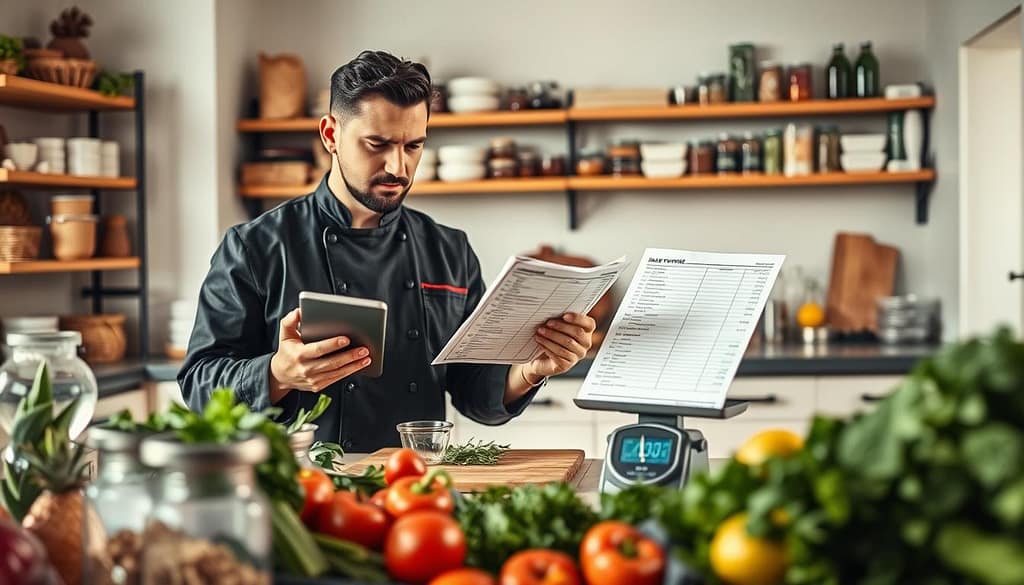
After negotiating, manage your ingredients well. Use an inventory management protocol that’s as strict as a librarian’s. FIFO—First In, First Out—is key. It helps avoid spoilage by using older items first.
But FIFO needs a good storage system to work. Label everything and keep your storage tidy. This isn’t just for looks. It helps you see what’s about to expire.
Then, there’s the waste log. It’s where you record every mistake. It’s not for blaming, but for finding patterns. Is your prep cook over-portioning? Is the spinach wilting too fast? The log will show you where to improve.
This leads to food prep optimization. Use standardized recipes and portion sizes. If your prep is too free-form, you’re wasting money. Train your team to be consistent. This will help keep costs down.
By using smart sourcing, strict inventory, and disciplined prep, your kitchen will change. It will become more efficient and cost-effective. Every dollar saved can be used for better ingredients or even a nice bottle of wine. That’s the real benefit of true food cost control.
Menu Engineering for Profit
Menu engineering is a secret in the culinary world that boosts profits without raising prices. It’s not just about making menus look good. It’s about using behavioral economics to make your menu more profitable. Think of it as directing a play where every dish is an actor, aiming to make your clients happy.
Menu engineering is all about data. You look at how popular an item is and how much profit it makes. This creates a simple grid that shows you how to make more money.
Every item on your menu fits into one of four categories. Knowing where each item fits is the first step to making more money.
- Stars: These items are both popular and profitable. They’re your top performers. Make sure they’re always available and highlighted.
- Puzzles: These items are profitable but don’t sell much. They need a bit of work to get noticed. Maybe change the name or description.
- Plowhorses: These items sell well but don’t make much money. They bring in customers. Use them to sell more Stars.
- Dogs: These items don’t sell well and don’t make money. It’s time to remove them. They waste resources and clutter your menu.
Knowing the categories is important. But knowing what to do with them is where the real profit comes from. Here’s what to do:
| Menu Item Type | Characteristics | Primary Goal | Strategic Actions |
|---|---|---|---|
| Stars | High Profit, High Sales | Protect & Highlight | Place in the “prime real estate” of your menu (top-right). Use visual cues like boxes or icons. Never run out of ingredients. |
| Puzzles | High Profit, Low Sales | Solve & Promote | Improve description, rename creatively, pair with a Plowhorse as a premium combo, feature as a “Chef’s Secret.” |
| Plowhorses | Low Profit, High Sales | Leverage & Optimize | Use to anchor the menu. Place near Stars to encourage trade-ups. Rigorously control portion and prep costs to improve margin. |
| Dogs | Low Profit, Low Sales | Eliminate or Re-engineer | Remove to simplify operations and reduce waste. Can they be re-priced, re-portioned, or re-imagined with cheaper ingredients? |
This strategic placement and presentation are where your professional branding meets tactical psychology. The fonts, colors, and layout that define your brand should guide the eye toward your Stars and Puzzles. A well-engineered menu is a silent, persuasive extension of your brand identity.
Ultimately, profitable menu design is not a one-time project. It’s an ongoing cycle of analysis and adjustment. By regularly categorizing your dishes and taking the actions outlined above, you transform your menu from a static price list into a dynamic, self-optimizing profit engine. That is the true power of menu engineering.
Waste Reduction Tactics
The industry’s dirty little secret isn’t in the pantry; it’s in the trash can. An average of 10% of all food purchased ends up there. For a personal chef, this is a big hit to your profits. It’s where food cost control really matters.
It’s about being a culinary detective, not just a cook. Your first clue? The waste log. It’s like a kitchen confessional.
Every peel, every spoiled herb, and leftover gets documented. This isn’t about feeling guilty. It’s about finding patterns. Is Monday’s fish ending up as Thursday’s science experiment? The log knows.
To turn your log into a strategy, analyze the culprits. Here’s a breakdown of common waste and how to stop it.
| Waste Type | Common Culprit | Financial Impact | Thrifty Solution |
|---|---|---|---|
| Spoiled Produce | Overbuying, poor storage | High; direct loss of unused inventory | Buy imperfect “ugly” produce at a discount; implement first-in, first-out (FIFO) organization. |
| Trim & Scraps | Inefficient prep, lack of reuse plan | Steady trickle of lost value | Collect vegetable ends for stock, herb stems for oils, meat bones for broth. This is foundational food cost control. |
| Plate Waste | Over-portioning, client preference | Direct loss of finished, sellable product | Conduct the “clean plate test.” Ask which dishes come back spotless and adjust portions silently. Menu-engineer out consistent losers. |
| Miscellaneous Misfires | Failed recipes, pilot dish experiments | Variable but demoralizing | Reframe as R&D cost. Log what went wrong. Sometimes a “failure” becomes next week’s special. |
Portion control is key in reducing waste. That extra spoonful of risotto? It’s profit walking out the door. Precise portioning is respectful to your ingredients and your client’s appetite.
The most advanced tactic is a mindset shift. See the value in what others discard. A wilted herb bundle becomes pesto. Stale bread becomes panzanella or breadcrumbs.
This creative reuse turns your kitchen into a circular ecosystem. It’s not just about saving money. It’s about being seen as resourceful and intelligent.
Mastering waste is the ultimate goal in culinary finance. It moves you from tracking expenses to creating value from discarded items. It turns food cost control into a chance for creativity, savings, and a cleaner conscience.
Adapting Menus Seasonally
Seasonal adaptation is more than just a trend. It’s a smart way to save money and impress customers. Think of it like this: serving strawberries in January is like buying a stock at its peak. You pay too much and get less flavor and value.
The clever chef watches the farmers market like a stock ticker. When zucchini is everywhere in July, it’s time to buy. Your food costs drop and your dishes get better. This is what makes a menu profitable—using nature’s sales.
| Approach | Cost Impact | Flavor Profile | Client Perception | Strategic Value |
|---|---|---|---|---|
| Rigid Year-Round Menu | High (imports, greenhouse) | Consistently mediocre | Predictable, safe | Low – vulnerable to price swings |
| Seasonal Adaptation | Low (local, abundant) | Peak intensity | Thoughtful, connected | High – builds anticipation |
| Hyper-Seasonal Focus | Very Low (glut pricing) | Exceptional, fleeting | Expert, exclusive | Premium – commands higher rates |
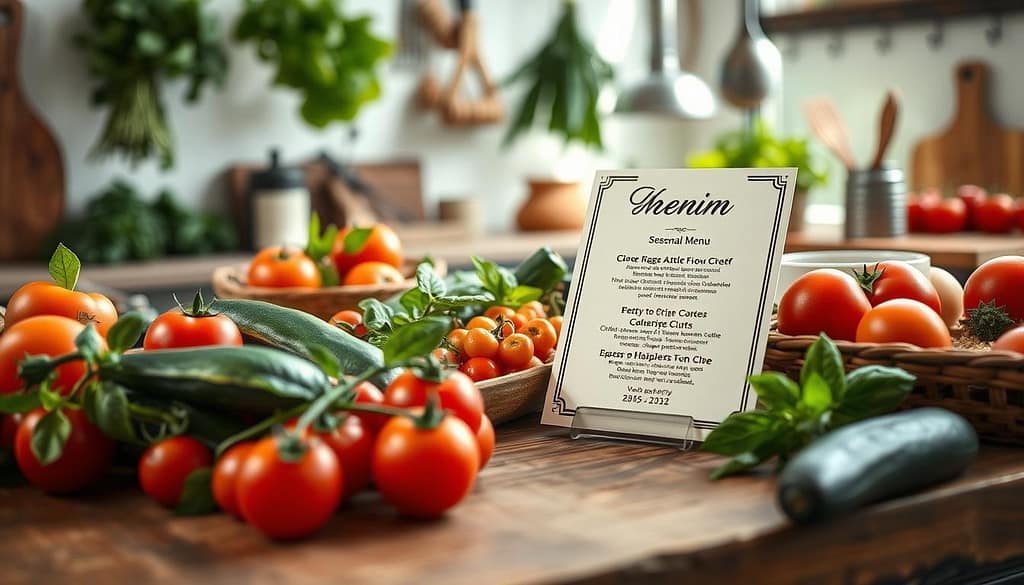
The best way to save money also makes your food better. It’s a win-win for both your business and your customers. They’re not just eating; they’re experiencing a moment in time.
This approach does more than cut costs. It creates scarcity in a world full of food. When asparagus is gone, people want it more. Your menu becomes an event.
Good seasonal menu planning means knowing the market. A late frost in California means more expensive stone fruits. You switch to berries. It’s not guessing; it’s managing your supply chain.
Innovation is key. When tomatoes are everywhere in August, you need new ideas. This turns experimenting into a way to make more money. Using up what’s in season keeps your menu fresh and profitable.
Listening to what customers want means telling a story with your food. They’ll pay for the tale of those heirloom carrots. Your menu becomes a journey through local farms.
To make this even better, promote your seasonal menus as special events. Make them seem exclusive. This creates a sense of urgency and justifies higher prices.
The beauty of seasonal menus is in their benefits. You save on food costs and offer more value. Less waste means happier customers. Your kitchen works smoothly, using what’s available and celebrating the fresh.
Ultimately, this approach makes you a master chef. You work with nature’s economy, not against it. You’re not just cooking with the seasons. You’re investing in them.
Monitoring Menu Performance
A menu without tracking is like a ship without a compass. You might be moving, but you don’t know where you’re going. You’ve set up your menu and prices for profit. Now, it’s time to see how it’s doing.
Forget the “set it and forget it” idea. It’s for gadgets, not your business. Your menu’s success is in every sale and every change.
It’s time to become a data detective. Look at your sales reports like a film critic. Are your best dishes selling well? Are new items a hit or a miss? This is about hard, profitable evidence.
Your Point-of-Sale (POS) system is key. It’s full of info on menu profitability. If you don’t have a fancy POS, a simple spreadsheet works too. The goal is to see everything clearly.
Change how you review your menu. Instead of monthly, do it weekly. This lets you make quick changes before problems get big.
What are you looking for? Look for the big differences. Here’s how to compare:
| Key Metric | Weekly Check Insight | Monthly Check Insight | Proactive Action Enabled |
|---|---|---|---|
| Item Sales Volume | Spots a sudden 20% drop in a Star item by week two. | Confirms the item had a bad month, but the “why” is lost. | Quickly investigate: Was it a supplier issue, a new competitor, or a social media complaint? |
| Food Cost Percentage | Catches a creeping cost increase on a high-volume dish. | Shows an overall cost overrun, but sourcing the culprit is harder. | Renegotiate with supplier or adjust portion size before the next shopping cycle. |
| Customer Feedback Trends | Notices repeated requests for a gluten-free modification on a Puzzle. | Sees a generic “dietary options” note in monthly summaries. | Test a permanent GF version next week, potentially turning a Puzzle into a Star. |
| Profit per Plate | Reveals if a price increase on the steak dish held sales steady or caused a revolt. | Tells you the average profit, masking the success or failure of individual changes. | Make confident pricing decisions and double down on what the market will bear. |
Let’s look at the last row. You raised the price on your signature steak. Weekly checks show if customers stayed loyal. If sales are good, you’ve boosted profit easily. If they drop, you know to act fast.
This process makes your menu dynamic. It’s not just a list; it’s a living financial guide. You’re not guessing; you’re acting on data.
Monitoring is like listening to your business. It’s the difference between driving blind and using a GPS. It turns worry into strategy and instinct into insight. Your menu profitability depends on this ongoing talk between your kitchen and the market.
Successful Menu Redesign Case Studies
Forget abstract spreadsheets. The true test of any financial strategy plays out in the gritty reality of a working kitchen. Let’s examine two chefs who transformed guesswork into a precise science.
First, meet Daniel R., a general manager at a high-volume pub. His old method? He’d basically guess his prices. This wasn’t strategy. It was hope. The turning point was implementing a rigorous costing system for every dish.
He aligned his pub menu with the hard truth of ingredient and labor costs. The result? His profit margins strengthened immediately. This is the power of disciplined chef menu pricing. It turns intuition into a calculable asset.
Then, there’s Amampreet P., a café owner. She sensed money was slipping away but couldn’t pinpoint the leak. A deep dive revealed waste was the silent budget killer. Her solution was a dual attack: a new financial structure and strict waste-tracking systems.
This wasn’t about being frugal. It was about being smart. The savings were instant and substantial. Her story is a masterclass in Profitable menu design, where every gram of unused avocado is accounted for.
These aren’t culinary fairy tales. They are replicable blueprints. Daniel and Amampreet didn’t have corporate budgets. They had problems and applied analytical solutions anyone can copy.
| Case Study | Primary Challenge | Strategic Outcome |
|---|---|---|
| Daniel R. (Pub GM) | Unsystematic, guesswork-based chef menu pricing leading to weak margins. | Implemented precise costing, realigned menu prices, and saw immediate margin improvement. |
| Amampreet P. (Café Owner) | Hidden operational waste eroding profits despite steady sales. | Adopted waste-tracking and financial restructuring, achieving instant cost savings and a more resilient Profitable menu design. |
| Your Kitchen | Undefined food costs and unmeasured prep waste. | The potential for 15-30% margin lift by applying these documented tactics. |
The lesson is clear. Mastering chef menu pricing and committing to strategic Profitable menu design isn’t just for chain restaurants. It’s the secret weapon for the independent culinary artist. Your case study is next.
Conclusion
Think of your menu as a living document, not a stone tablet. We’ve looked at how profit works, from food costs to what sells. Making a menu is a delicate balance every chef must master.
Financial Management is your kitchen’s silent partner. It supports your creativity, not hinders it. This ongoing effort turns a hobby into a business. Pricing and menu engineering are daily tasks, not one-time projects.
Your creativity needs a solid base. Cutting waste and using seasonal ingredients are smart moves. They help your business grow. Be smart with your ingredients and creative with your presentation.
The aim is simple: let your passion earn you money. Master your finances to free up your creativity. Your bank account should grow as much as your clients’ satisfaction. Start combining your taste and profit goals today. Your sustainable feast is waiting to be made.