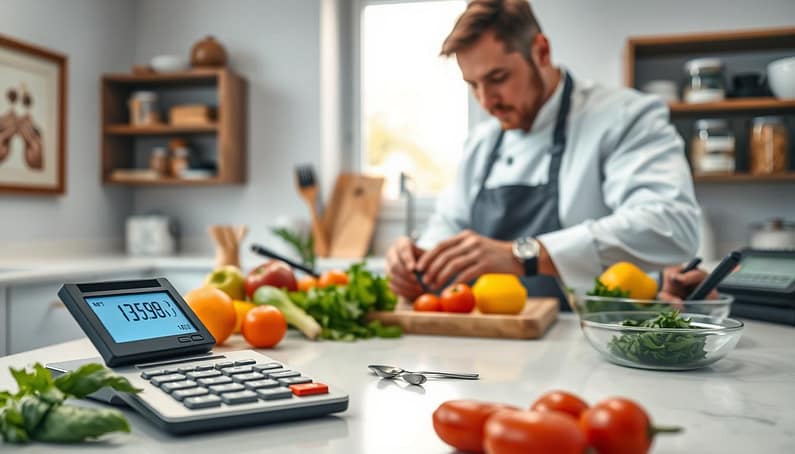
The magic of making a perfect Beef Wellington in a client’s home wears off quickly. It’s like a poorly tempered chocolate. Your money becomes a mystery, like something Sherlock Holmes would solve.
This isn’t just about loving food. It’s about keeping your passion from eating away at your savings. You don’t want your business to become a hobby that costs too much.
I’m here to help you manage your finances. We’ll tackle big numbers, like the $55,792 in monthly running costs in the industry. We’ll break them down into steps you can follow.
It’s like moving from a chaotic kitchen to a calm, financial office. A budget calculator is as important as your favorite knife. It’s your new essential tool.
So, why is a simple budget so important? It’s the difference between a successful business and a chaotic hobby. A good budget keeps your business on track.
Why Personal Chefs Need a Budget
Running a personal chef service without a budget is like trying to bake a soufflé in a broken oven. It won’t be profitable or pretty. Your financial model is unique. You’re not serving a dining room full of predictable patrons.
Your income comes from intimate, high-value transactions that can change on a dime. A client’s sudden pivot to a gluten-free, vegan, keto paella isn’t just a culinary challenge. It’s a financial variable waiting to pounce.
Let’s analyze the cold, hard data. Your most significant fixed cost isn’t truffles or Wagyu beef. It’s payroll. Before you’ve even purchased an avocado, you could be on the hook for nearly $50,000 a month in chef and staff salaries. That’s a mountain of fixed expense you must climb every single month, rain or shine.
Then come the variables. Chef travel, targeted marketing, and of course, the food itself. Left unchecked, these variable costs can conspire to reach a staggering 185% of your revenue. Think about that for a second. You’re spending $1.85 for every $1.00 you bring in. This isn’t a business model; it’s a one-way ticket to a negative contribution margin and, as the data projects, a negative EBITDA in your first year.
A budget is your strategic recipe to prevent this disaster. It transforms you from a reactive artist into a proactive CEO. It answers the critical question: how do you ensure your artisanal craft doesn’t devolve into a very expensive, very stressful philanthropic hobby?
The contrast between winging it and planning is stark. The table below lays out the brutal financial reality.
| Financial Aspect | Scenario: No Budget (Flying Blind) | Scenario: With a Budget (Strategic Plan) |
|---|---|---|
| Primary Fixed Cost (Payroll) | A looming, unchecked monthly drain of ~$49,792. Feels like an anchor. | A planned, non-negotiable line item. You build your pricing and client load around it. |
| Variable Costs (Food, Travel, Marketing) | Can spiral to 185% of revenue. Each client request becomes a financial mystery. | Tracked and capped as a percentage of revenue. You know your limits before you shop. |
| Year-One Profitability (EBITDA) | Projected to be negative. You are funding your client’s dinners out of your own pocket. | A clear path to positive territory. You can see the losses shrinking month over month. |
| Business Mindset | Reactive. You are constantly putting out financial fires. | Proactive. You make decisions based on data, not panic. |
| Long-Term Outcome | Burnout and closure. The “philanthropic hobby” model is unsustainable. | Controlled growth and sustainability. Your art supports your life, not the other way around. |
This isn’t about stifling creativity. It’s about funding it. Budgeting for chefs is the framework that gives you the freedom to be brilliant. It tells you exactly how much you can spend on that exotic spice or that premium cut without jeopardizing your ability to pay your own rent.
Without this plan, you’re just hoping for the best. With it, you’re engineering your success. You move from being a cook who runs a business to a businessperson who excels at cooking. That shift starts with a simple, powerful tool: your budget.
Identifying All Business Income Sources
Revenue mapping isn’t just about numbers. It’s like knowing every ingredient in your mise en place. To manage your chef business expenses wisely, you need to know where every dollar comes from.
This isn’t just about counting client fees. Think of your income as a financial ecosystem. Are you making money from one-off events or steady clients?
Let’s look at all the ways you can make money. Your main income might come from private chef services. But what about other smaller sources?
Meal prep subscriptions for busy families can be a big help. Virtual cooking classes can reach people all over the world. And adding things like wine pairings or special ingredients can really boost your profits.
Even fees for kitchen design or nutrition advice count. Each source helps make your business stronger.
Why is this important? Finding out that one service makes up 60% of your income changes everything. You’ll focus on growing that service.
This makes your income feel real and something you can work with. You’ll stop guessing and start making plans.
This step helps you build a business that can handle ups and downs. Having different income sources protects you from losing clients. It also helps you manage your chef business expenses better.
Don’t forget that getting new clients is also a way to make money. Using booking platforms to find new clients can make marketing work for you, not against you.
Make a simple table to see how you’re doing now. It’s not about complicated spreadsheets. It’s about being clear.
| Income Stream | Current % of Revenue | Growth Potentail |
|---|---|---|
| Private Chef Services | Estimate % | High/Medium/Low |
| Meal Prep Subscriptions | Estimate % | High/Medium/Low |
| Cooking Classes/Events | Estimate % | High/Medium/Low |
| Consultations & Add-ons | Estimate % | High/Medium/Low |
Fill in your guesses. The goal is to see what’s holding you back. If one thing is doing all the work, your business is at risk.
This first step is key. You can’t budget well without knowing your income. Knowing exactly how much money you make lets you spend wisely.
This makes managing your chef business expenses easier. You can focus on what makes money and cut costs on what doesn’t.
Start this audit today. Open a new document and list every way you made money last quarter. You might be surprised by what you’ve been missing. That surprise is the start of taking control.
Comprehensive Expense Tracking
Financial visibility is not just about saving money. It’s about knowing where your money goes. This includes everything from truffle oil to tax software. It’s about turning your profit and loss statement into a strategic tool.
Expense tracking is like preparing for a meal. You need to measure and account for every ingredient before you start. If you miss one, your whole dish, or profitability, falls apart.
We will look at the seven key expenses that every successful personal chef tracks. These are the real costs that can affect your bottom line.

First, there’s personnel wages. Even if it’s just you, this must be a formal expense. Office rent is also a legitimate expense, and you must track it. Legal and accounting fees are essential for your business.
Then, there’s software. That forgotten subscription can add up. But the big costs are where the drama is.
Chef travel reimbursement can be up to 40% of your gross revenue. This includes miles, meals, and parking. Performance digital marketing can take up to 50% of revenue for new clients.
And don’t forget liability insurance. Skipping this $800-a-month policy is risky. It’s like serving raw chicken.
Now, let’s talk about ingredients. Using a food cost calculator is key. You need to move beyond guessing.
Your food cost percentage is critical. It’s the cost of food divided by the menu price. Aim for 28-35%. If you’re not calculating this, you’re losing money.
Waste tracking is also important. That wilted cilantro or extra sauce? It’s money in the trash. Precise ordering and portion control come from tracking waste.
Using a food cost calculator means you know the exact cost of dishes. This precision is powerful.
Here is a breakdown of the core expenses you need to track. This is your recipe for financial clarity.
| Expense Category | Description & Impact | Typical Benchmark/Note |
|---|---|---|
| Personnel Wages | Salaries for you or any staff. Your own pay is a cost of doing business. | Varies widely; factor in taxes and benefits. |
| Office Rent | Cost for a commercial kitchen space or a dedicated home office. | Home office deductions require strict tracking. |
| Liability Insurance | Essential protection against client illness or property damage claims. | ~$800/month; never skip this. |
| Legal/Accounting Fees | Cost for business formation, contracts, tax filing, and financial advice. | An investment in compliance and risk reduction. |
| Software Subscriptions | Booking, scheduling, accounting, and communication platforms. | Audit annually; cancel unused services. |
| Chef Travel Reimbursement | Mileage, tolls, parking, and meals while traveling to clients. | Can be up to 40% of gross revenue. |
| Performance Digital Marketing | Paid ads on social media or Google aimed at direct client acquisition. | Can consume 50% of revenue during growth phases. |
This table is more than a list. It’s a tool to diagnose your finances. Are your travel costs near 40%? If not, you might be under-claiming. Is marketing below 10%? You might be under-investing in growth.
Comprehensive expense tracking turns your finances into a proactive strategy. You stop wondering where the money went. You start directing where it goes next.
Implementing a rigorous system, like a food cost calculator app, gives you control. It turns your P&L into a real-time dashboard for your culinary empire.
Budgeting Tools and Software
The $700 monthly on software should help you, not hurt. It’s time to check your tech tools. That old spreadsheet? It’s outdated. True budgeting for chefs means using tools that work together, freeing you to be creative.
Think of it as your financial mise en place. A budgeting app like QuickBooks is your base. But the real magic is when your scheduling and CRM apps feed data into it. This makes your budget dynamic and alive.
So, what does $700 buy? It gets you a digital kitchen assistant. It saves you from manual errors and gives you real-time insights. This means you can focus on making this month a success.
Your tool choice depends on your size. Solo chefs might do well with:
- Wave for free accounting and invoicing.
- Google Sheets with smart templates for cash flow.
- Your bank’s app for mobile receipt scanning.
For growing chefs or small agencies, you need a strong platform. It should handle everything from proposals to expense tracking. The goal is to have one place for all your business needs.
This isn’t about doing accounting. It’s about creating a business dashboard. The right tools make your work easier, not harder. They help you make smart decisions before you even think about them.
Your knife kit has a purpose for every tool. Your budgeting software should be the same. Choose tools that work hard for you, turning data into clear decisions for your business.
Preparing for Seasonal Fluctuations
Managing a personal chef’s finances is like planning a farm’s harvest. Your earnings don’t stay the same. They change with your clients’ plans and tastes.
The “holiday party season” is your busiest time. Then, the “New Year’s resolution detox” season brings a demand for healthy foods. But, the “everyone’s on vacation” summer can slow things down. Did you think their beach trip wouldn’t affect your bottom line?
Having a fixed budget is like wearing a winter coat in July. It can choke your finances. You need to adjust your spending like a sailor changes course.
Look at your past earnings and expenses to predict the future. How much did you make last November? What were your chef business expenses in slow August? This isn’t just keeping records. It’s planning ahead.
With this knowledge, you can save money during the busy times. Think of it as your “culinary hibernation fund.” It helps during the slow months, so you don’t have to lower your prices. Keeping your profits up keeps you sane.
This smart planning helps you manage your time and resources. You plan your hours and inventory wisely. You also time your marketing to boost sales before a slow period. Your entire business rhythm matches the seasons.
Preparing for slow times means you’re always in control. You keep your prices steady. Your chef business expenses become predictable, even when your income isn’t. You turn uncertainty into a manageable part of your business.
This is the key to success. Your budget is a flexible tool that adapts to the seasons. It turns your cooking skills into a steady, profitable business.
Reviewing and Adjusting Your Budget Regularly
Think of your budget as a GPS, not a stone tablet—it needs constant recalibration to navigate the ever-changing culinary landscape. A budget drafted in January is as useful as a July snowplow by June. Ingredient costs inflate, a new competitor sets up shop down the street, and your most reliable client moves across town. Your financial plan must be a living, breathing document.
The magic isn’t in creating the perfect budget on day one. It’s in the discipline of regular expense tracking and review. I advocate for a monthly ritual I call “Financial Friday.” Block out thirty minutes. This is your tactical debrief, not a session of financial self-flagellation.

During this review, you have one mission: compare your actuals to your projections. Did you spend 20% more on gasoline last month because you landed a fantastic new client in the suburbs? That’s not a failure; it’s intelligence. Did a specific marketing effort, like optimizing your profile on booking platforms to attract new clients, suddenly become far more efficient? That’s a win to double down on.
This process turns your core expense tracking data into a strategic dashboard. You’re looking for variances—the gaps between what you planned and what happened. A variance isn’t inherently good or bad. It’s simply information. A positive variance in income? Celebrate it, then analyze what drove it. A negative variance in a supply category? That’s a leak to plug before it becomes a flood.
The true power of this monthly check-in is its proactive nature. Meticulous expense tracking reveals patterns long before they become crises. You notice a creeping increase in specialty oil costs over three months, giving you time to source a new supplier or adjust your menu pricing. You see that your summer marketing spend isn’t yielding the same returns, so you pivot your strategy before the fall slump.
This isn’t accounting. This is business intelligence. You are the commander getting a sitrep from the front lines. Without this regular heartbeat of review, your budget is just a historical artifact—a record of what you thought would happen. With it, your budget transforms into a dynamic strategy, agile enough to capitalize on opportunity and resilient enough to withstand surprise.
Set the calendar reminder. Make the coffee. Your future, more profitable self will thank present-day you for this half-hour of clarity.
Budgeting Mistakes to Avoid
Most budgeting failures in the culinary world aren’t due to complex math. They’re caused by simple oversights. We’re about to explore common financial blunders. Each one is a cautionary tale from the past.
The first mistake is the “Optimism Budget.” It’s like writing a fantasy novel. The projected revenue is high, and expenses are vague. But reality is a harsh editor.
When you crunch the numbers, you find a shocking truth. Variable costs are 185% of revenue. This means you’re losing money. It’s not a business; it’s an expensive hobby.
Next, we have the “Fixed Cost Blind Spot.” Chefs often focus on food costs. But fixed costs like payroll and rent are ignored. These costs can sink your business.
Under-insurance is another risk. One kitchen fire or liability claim can be devastating. It’s a cost you forgot to budget for.
Then, there’s the “Miscellaneous: The Black Hole.” This is where small expenses add up. A few dollars here and there can cost hundreds a month. It’s about tracking waste and overordering.
Staffing inefficiencies also fall into this category. Idle time for staff can cost a lot. It’s a hidden expense that hurts profitability.
The final mistake is not including a personal salary in the budget. This makes you an unpaid intern. You might see money in the account, but it’s not yours.
This mistake makes it hard to know if your business is sustainable. It blurs the line between personal and business needs. It’s like running a charity that feeds everyone but the founder.
Each mistake is a detour on the road to profitability. Recognizing them early can save your business. Treat your budget as a dynamic map to avoid these pitfalls.
Using Budgets for Growth and Planning
Most budgets feel like a diet plan. Yours should feel like a treasure map. This is where you elevate your budgeting for chefs from a chore to a chess game. You’re no longer just tracking pawns; you’re moving queens.
Think of it as shifting from defensive to offensive finance. Defense is about not overspending on truffle oil. Offense is about using your financial data to fund a new marketing campaign or a kitchen assistant.
Your historical budget is the raw material for your financial projections. It answers the critical question: “What do I need to earn to make this new idea viable?”
| Budgeting Mindset | Primary Focus | Key Question | Outcome |
|---|---|---|---|
| Defensive (Basic) | Tracking & Survival | “Did I stay within my grocery budget this month?” | Cash flow stability, avoiding debt. |
| Offensive (Strategic) | Projection & Growth | “What monthly revenue do I need to hire a sous chef and net 15% more profit?” | Funded expansion, increased market share. |
| Visionary (Planning) | Capital & Scale | “How much buffer capital do I need to lease a commercial kitchen by May 2027?” | Business transformation, asset acquisition. |
That last row is key. Planning for a major leap—like a dedicated kitchen space—requires modeling a capital buffer. Recent analyses suggest a prudent buffer for such a move can be around $462,000. This isn’t just savings; it’s growth capital. Your budget model tells you how long it will take to accumulate it.
This is where your food cost calculator transitions from a basic tool to a strategic crystal ball. It’s no longer just about what a dish costs, but about what it earns and who it attracts.
Use it to run scenarios. What if you increased prices by 8% but added a premium amuse-bouche? Would you attract higher-value clients? What’s the profit margin on your most popular vegan tasting menu versus your classic steak dinner?
This data directly informs your service packages and target client profiles. Maybe your budget reveals that intimate, high-priced dinners are your most profitable lane. Double down there.
Your budget becomes the business plan for your next phase. Want to hire help? The model shows the exact additional weekly revenue required to cover that salary while maintaining your profit. It moves you from hopeful guessing to deliberate, funded growth.
That’s the essence of strategic budgeting for chefs. It’s not a cage locking you in. It’s the launchpad that calculates the exact thrust needed for liftoff, using hard data from your food cost calculator as the fuel.
Recommended Resources and Templates
Forget the marketing fluff; here’s a list of real resources for the independent chef. You need tools, not every app out there. A good toolkit makes expense tracking easy, not a second job.
Why start from scratch when you can use a proven template? A good template is like a recipe—it gives you structure. This lets you focus on your unique numbers.
I suggest a simple spreadsheet with three parts: Income, Fixed Costs, and Variable Costs. The Variable column is key. Log every market run, gas fill-up, and garlic purchase here. This detailed view shows where your money goes, turning vague worries into clear data.
For digital tools, you need software that works well together. Consider a trio:
- POS & Invoicing: Square or Toast. They’re more than payment processors. Their reports automatically categorize sales, helping with expense tracking.
- Scheduling & Client Management: Calendly or HoneyBook. These tools help avoid missed appointments and lost income.
- The Budgeting Hub: QuickBooks Self-Employed or Google Sheets templates work well. The key is logging expenses daily, not quarterly.
Ingredients are your biggest variable cost. A reliable wholesaler like CHEF’STORE helps with cost predictability. It’s about consistent pricing and quality, making forecasting easier.
But are your numbers good? Are you charging enough? Community benchmarking helps. Platforms like the American Personal & Private Chef Association (APPCA) forums offer valuable insights. Peers share data on food costs and pricing, helping you set rates.
To summarize, here’s a look at the essential tools. Think of this as your financial success equipment list.
| Resource Type | Specific Tool/Resource | Primary Function | Best For Chefs Who… |
|---|---|---|---|
| Budgeting Template | Adaptable 3-Column Spreadsheet | Categorizes Income, Fixed, & Variable Costs | Prefer hands-on control and want a free, flexible starting point. |
| POS & Sales Software | Square for Restaurants | Processes payments, tracks sales categories, generates simple reports. | Need an all-in-one system for invoicing, menu pricing, and basic sales analytics. |
| Scheduling & CRM | HoneyBook | Manages client inquiries, books appointments, sends contracts and invoices. | Want to automate the client journey and reduce time spent on admin. |
| Dedicated Accounting | QuickBooks Self-Employed | Automatically imports and categorizes bank transactions, estimates taxes. | Want to streamline bookkeeping and have clear data for tax season. |
| Supplier Partnership | CHEF’STORE (or local wholesale equivalent) | Provides consistent ingredient pricing and bulk purchasing options. | Seek to stabilize their largest variable cost and improve profit margin predictability. |
| Benchmarking Community | APPCA Member Forums | Offers peer insights on industry-standard rates, costs, and business practices. | Feel isolated and want to validate their financial performance against the market. |
This toolkit isn’t about adding more work. It’s about installing guardrails and autopilot functions for your finances. The right template gives you clarity. The right software cuts the busywork. The right supplier relationship removes guesswork. And the right community tells you if you’re on track. Implement these, and expense tracking becomes your most powerful business intelligence system.
Conclusion
Let’s get to the point. Mastering your numbers is key, not just a side dish to your cooking skills. A budget is like a silent partner in your kitchen. It keeps the lights on while you create your signature dishes.
We explored why tracking every dollar is important and how to manage your chef business expenses. You found ways to make money, sorted out costs, and learned to use tools like QuickBooks or spreadsheets. You also planned for slow times and set up a system for regular checks.
This journey changes you. You’re no longer just a cook dealing with bills. You become a business owner with a plan for financial success. Managing your expenses well gives you freedom. It lets you buy better ingredients, new equipment, and ensures stability.
Think of your budget as your most reliable recipe. Follow it, taste as you go, and adjust as needed. Now, use that control to make your art profitable and sustainable. Your next great creation is waiting for you.