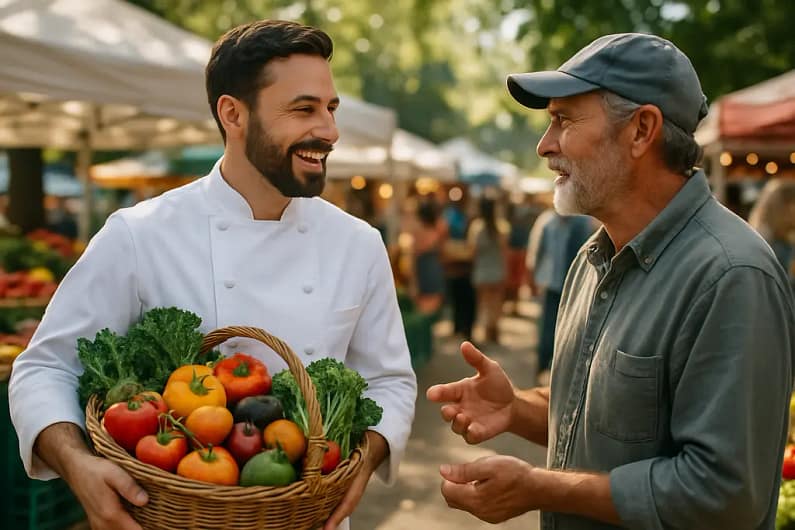
Building relationships with local food producers can help a personal chef create clearer menus, stronger client conversations, and more dependable sourcing habits. The goal is not to chase every seasonal ingredient or promise a farm-to-table menu before the supply is ready. The goal is to build a practical network that supports the way you actually cook for private households, small events, meal prep clients, and special occasions.
As Jordan Reyes, I look at producer networking as a business development habit, not a one-time sourcing errand. A chef who knows which growers, ranchers, fishmongers, bakers, and specialty makers can reliably serve small-volume buyers has more room to design seasonal menus with confidence. That can also help clients understand why a menu changes from month to month, why some ingredients need advance notice, and why a locally sourced dinner may require a different planning timeline than a standard grocery run.
Why Local Food Producers Matter For Personal Chefs
How Local Food Producers Shape Menu Promises
Working with local food producers changes the way a personal chef talks about food. Instead of offering a menu that sounds fixed year-round, you can describe a flexible menu framework: greens when quality and availability are strong, stone fruit when the season supports it, storage crops when they make more sense, and prepared pantry items when they add value without creating supply strain.
This matters because personal chef clients often book for convenience, trust, and a better dining experience at home. They may appreciate local sourcing, but they still need you to manage timing, budget, dietary preferences, and service flow. The producer relationship should support those needs rather than complicate them. If a grower has beautiful produce but limited harvest windows, that information belongs in your planning notes before it appears on a client proposal.
What The USDA Numbers Suggest
The market for direct food sales is not a small side channel. In 2022, U.S. producers sold $17.5 billion in food through direct marketing channels, including farmers markets, CSAs, restaurants, institutions, and other buyers; that was about 25 percent higher than in 2017 after adjusting for inflation, according to the USDA Economic Research Service direct sales data. For personal chefs, that figure supports a practical point: many farms and food businesses are already working outside conventional wholesale channels, so a chef who approaches them professionally may fit into an existing sales pattern.
The USDA National Agricultural Statistics Service also described its Local Food Marketing Practices Survey as covering 2025 production and marketing practices, including sales to consumers, retail buyers such as restaurants, institutions, and intermediaries. The survey was scheduled for early 2026 and involved about 64,496 producers, according to the USDA survey guide. That scope is useful for chefs because it shows how many types of local food sales channels may overlap with personal chef sourcing.
Start With Fit Before Asking For Supply
Map Your Menu To Their Crop Calendar
A strong first conversation is not, “What can you sell me?” A better starting point is, “Here is how I cook, here is how often I buy, and here is the type of notice I can usually give.” Producers need to know whether you are seeking two bunches of herbs for a dinner party, mixed vegetables for weekly meal prep, cases of fruit for preserves, or a standing order for eggs, meat, dairy, or pantry goods.
Before you ask for pricing, map your most common menus against the producer’s likely season. A personal chef who cooks Mediterranean-inspired family dinners, for example, may need herbs, greens, tomatoes, beans, lamb, or cultured dairy at different points in the year. A chef focused on brunch service may care more about eggs, fruit, baked goods, cheese, and jams. This exercise keeps your outreach respectful because you are not asking a producer to solve a vague sourcing wish list.
Ask Operational Questions Early
Operational details are where many chef-producer relationships succeed or stall. Ask how the producer prefers to receive orders, how much notice they need, where pickup happens, whether delivery is possible, and how substitutions should be handled. If you need invoices for business records, say that early. If you can pay on pickup, explain that. If a client cancels often, be honest about whether you can still commit to advance orders.
A simple outreach message can work well: introduce your service area, the type of clients you cook for, your average order size, and why their products may fit your menus. Keep the note short. Producers are busy, especially during market days and harvest periods. The purpose of the first message is to start a conversation, not to request a full catalog, private tour, and custom pricing all at once.
Turn First Meetings Into Useful Working Agreements
Keep The First Order Small
A first order should test communication, quality, packaging, timing, and your own ability to use the product well. Start with ingredients you already know how to cook. If the relationship works, you can build toward more seasonal planning, larger menus, or special client dinners. If the fit is not right, a small test order keeps the learning process low-pressure for both sides.
This approach is especially useful for personal chefs because client work often happens in private homes with limited storage and fixed service times. Unlike a restaurant, you may not have a walk-in cooler, prep team, or daily specials board to absorb last-minute product changes. A producer may have excellent food, but you still need to judge whether the ordering rhythm fits the scale of your business.
Make Payment And Pickup Clear
Clarity around payment builds trust quickly. Confirm whether the producer accepts cash, card, check, invoice payment, or electronic transfer. Ask whether prices are set weekly, seasonally, or by order size. If you plan to feature their name in a client menu, ask permission. Some producers welcome that visibility; others may prefer quiet wholesale relationships.
- Confirm ordering deadlines before promising a menu to a client.
- Ask how the producer handles shortages or substitutions.
- Keep a record of product quality, pack size, price, and pickup time.
- Pay on the agreed schedule, even when your own client pays later.
- Share useful feedback, such as how a product performed in prep or service.
If you want a companion planning piece on supplier outreach, this related article on local producer networking offers another practical angle for turning conversations into steadier sourcing habits.
Use Producer Stories Without Overpromising
Give Clients Specific But Careful Language
Clients often respond well to source details, but the wording should be accurate. “This salad uses greens from a nearby farm I work with” is clearer than broad claims that cannot be verified. Avoid implying that every ingredient on the table came from a nearby producer unless that is true. If only the carrots and cheese are local, say that. Precision protects your credibility and respects the producer’s work.
Good client language can also manage expectations. You might say, “I can design a seasonal menu using several regional ingredients, then confirm exact items after I check availability.” That keeps the proposal appealing without locking you into a product that may not be harvested, processed, or packed in time for the booking.
Connect Local Sourcing To Client Service
Producer relationships are not only about the ingredient list. They can improve the client experience by giving you better stories, fresher planning cues, and more confident explanations. If a client asks why a menu changed from asparagus to green beans, you can explain that the menu follows availability rather than forcing an ingredient out of season. For guests who enjoy restaurant-style hospitality, reviewing a polished dining site such as De Novo Montclair can also remind chefs how clear presentation and guest expectations shape the dining experience. For more inspiration, visit De Novo Montclair.
The key is to keep sourcing language grounded. Do not use producer stories as a substitute for good service, punctual communication, accurate quotes, and well-executed food. A beautiful farm connection cannot fix a confusing proposal or late arrival. Your network should strengthen the service clients already expect from a personal chef.
Building A Strong Network With Local Food Producers
A working network of local food producers grows through repeat contact, not one impressive meeting. Visit markets with a plan, introduce yourself briefly, buy something before asking for favors, and follow up after you have used the product. If a producer is not a fit now, keep the relationship warm. Your service model may change, their distribution may change, or a future client may need exactly what they offer.
Track each contact in a simple system: name, product category, order method, lead time, minimum order, pickup location, payment preference, and notes from past orders. This record turns casual networking into business memory. It also helps you avoid asking the same basic questions every season.
For personal chefs, the strongest local sourcing plan is practical, honest, and repeatable. Build slowly, communicate clearly, and protect the trust of both the producer and the client. That is how a sourcing contact becomes a useful business relationship rather than a one-time ingredient hunt.