Let’s get to the heart of the matter. Running a culinary business without the right coverage is risky. It’s like serving coq au vin without checking the chicken—a guaranteed recipe for financial disaster.
Talented chefs often think their skills are enough. But a single mistake—a slip, a spoiled ingredient, a misunderstood allergy—can lead to a lawsuit. This can cost $15,000 or more. That’s a big hit.
This isn’t about fear; it’s about being smart. Think of the right business insurance as your non-negotiable kitchen armor. It’s the financial fire extinguisher you hope to never use. But you also need the right licenses, permits, and DBAs. They show you’re a professional.
Getting this foundation right is as important as smart tax planning. It’s all part of building a strong, legitimate operation. So, what does this essential Personal Chef Insurance actually cover? Let’s break it down.
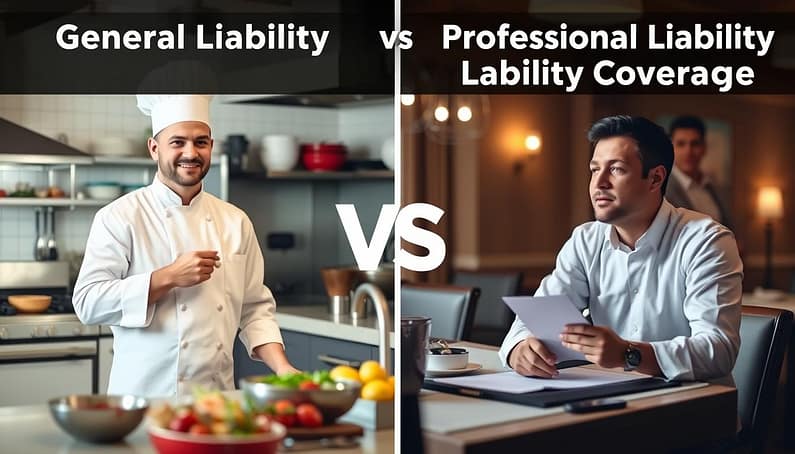
General Liability vs Professional Liability Coverage
Let’s get to the point: one policy protects your client’s marble countertop from your knife. The other protects your reputation from their claim. Knowing this is key to any chef insurance plan.
General Liability is for the physical world. It’s like a financial safety net when things go wrong. This includes third-party bodily injury or property damage. For example, if a guest slips on spilled olive oil or your assistant breaks a vase, this policy covers it.
A chef dropping a knife and causing a $3,800 gash in a client’s marble countertop is a General Liability claim. It pays for the repair. The cost for this liability insurance is usually between $400 and $1,500 a year. It’s a small price for peace of mind.
Professional Liability, or Errors & Omissions (E&O), deals with the intangible. It defends your judgment, skill, and service. If a client says your seared scallops made them sick or you mislabeled an ingredient, this policy helps.
This coverage pays for legal fees, settlements, and damage control when your work is questioned. It’s like having a lawyer in court. The cost is between $500 and $1,000 a year.
You need both policies. One for the broken tile and the other for the broken trust. General Liability handles accidents on set. Professional Liability fixes issues with your expertise.
| Feature | General Liability Coverage | Professional Liability Coverage |
|---|---|---|
| Primary Protection | Third-party bodily injury & property damage | Negligence, errors, omissions in professional services |
| Common Scenarios | Slip-and-fall accidents, damage to client’s home | Alleged foodborne illness, incorrect advice, breach of contract |
| Typical Annual Cost | $400 – $1,500 | $500 – $1,000 |
| Key Differentiator | Covers physical mishaps | Covers intellectual or service failures |
| Analogy | The stunt double for your business | The legal defense for your reputation |
Building a complete liability insurance portfolio is not just one or the other. It’s about having both. Your General Liability policy protects you in the kitchen. Your Professional Liability policy defends your reputation in court. For more details, check out our liability insurance FAQ. Knowing what each policy covers is key for any culinary professional.
Food Handler Certification & Health Permits
Before you can legally sauté a scallop for a client, you must first pass a government-mandated test on temperature danger zones. Think of it as your culinary bar exam, but with more bacteria and less precedent. This isn’t about your knife skills; it’s about proving you won’t accidentally host a salmonella party.
Your local health department runs this show. They require a food handler permit, which you earn by attending a seminar that’s about as exciting as watching butter clarify. You’ll learn about food-borne illnesses, cross-contamination, and that critical temperature range between 41°F and 140°F—the real “Danger Zone.” (Sorry, Kenny Loggins.)

Here’s the kicker: applying for these food handler permits often requires proof of insurance. The health department wants to know you’re covered if your hollandaise sauce goes rogue. It’s a classic bureaucratic chicken-and-egg scenario.
Now, let’s talk business structure. You have two primary paths: the DBA and the formal business license.
Choosing a DBA (“Doing Business As”) is like cooking in your pajamas. It’s fast, informal, and lets you use a catchy business name. But it offers zero legal separation between you and your business. You are personally liable for everything. If a client sues, they’re coming for your personal assets—your home, your car, your prized copper cookware.
A formal business license, often as an LLC or corporation, is like suiting up for service. It creates a legal entity that stands between you and professional disaster. It’s more paperwork upfront, but it shields your personal life from your business mistakes.
The table below breaks down the key differences. It’s the menu for your legal entrée.
| Feature | DBA (Doing Business As) | Formal Business License (e.g., LLC) |
|---|---|---|
| Legal Protection | None. You are the business. | Strong. Separates personal and business assets. |
| Setup Complexity | Low. Usually just a registration form. | Moderate to High. Articles of organization, operating agreements. |
| Typical Cost | $50 – $150 | $100 – $500+ (plus state fees) |
| Insurance Implications | Personal liability exposure is high. | Liability is directed to the business entity. |
| Ideal For | Very low-risk, side-gig testing. | Any serious, full-time personal chef operation. |
But wait, there’s more. Your chef certification journey has a plot twist. If you prepare food in your own kitchen and deliver it to a client, you’ve just become a caterer in the eyes of the law. This isn’t a promotion; it’s a regulatory shift.
Delivering cooked food typically requires a caterer’s license. This means your home kitchen may need to pass a health inspection. Suddenly, that crumb in your toaster is a code violation. The logic is simple: once you leave the client’s premises, the health department can’t vouch for your cooking environment.
Navigating this requires strategy. Will you only cook in client homes? Then your primary hurdle is the standard food handler permit. Do you plan to meal-prep and deliver? You’re looking at a caterer’s license, which often has stricter equipment and facility requirements.
This entire process—permits, licenses, certifications—is the unglamorous foundation of your business. It’s the mise en place of legality. Skip it, and you risk a shutdown notice from a stern health inspector who has no appreciation for your perfect soufflé. Get it right, and you build a business that’s not just creative, but compliant and protected.
Workers Compensation Considerations
Workers’ compensation is a key part of any food business insurance plan. It’s not something you brag about, but it’s essential. It shows you’re serious about your business, not just a hobby.
When you hire your first employee, you become an employer. This is not optional; it’s the law in most places. It’s a way to protect your workers and your business.
The cost of workers’ comp varies, but it’s worth it. It can be between $1,200 and $3,000 per year for each employee. Without it, you could face huge bills for injuries.
Imagine an assistant chef getting hurt lifting a heavy cooler. The bill could be $39,800. With workers’ comp, this is covered. Without it, you’d have to pay it all yourself.
The system is strict because it’s designed to protect everyone. It covers medical costs and lost wages for work-related injuries. This keeps your business safe from lawsuits.
The rules vary by state. In California, the rules are strict and expensive. In Texas, it’s mostly up to the employer. Knowing these rules is important for good business insurance planning.
Think about how you view safety in your business. Is it a priority, or an afterthought? Your answer can tell you a lot about your business.
Workers’ compensation is a big test. It shows if you’re serious about your business or not. For any serious food entrepreneur, it’s not optional. It’s a smart investment in your business’s future.
Client Property Protection Strategies
Your client’s Persian rug wasn’t on the menu, but a spill could ruin it. Working in someone else’s space can be risky. Strategic asset shielding is smart, not just being paranoid.
What if your cooking causes damage to your client’s countertop? Your liability insurance helps. It covers big mistakes, like a kitchen fire that damages $15,000 worth of things. This policy helps keep your costs down.
But what about your own tools? Knives, immersion circulators, and plating gear are key to your work. Inland Marine Insurance protects these when you’re on the move. It’s a small price to pay for peace of mind.

Transporting your mise en place, a cake, or equipment is risky. If you get into an accident, your personal auto won’t cover it. You need Commercial Auto Insurance for business use. It costs between $1,200 and $2,400 a year.
The best strategy is to have a moat. Use General Liability for their space, Inland Marine for your gear, and Commercial Auto for travel. This combo protects you from many risks. It turns worry into a plan, and disaster into something manageable.
Annual Insurance Cost Planning
Think of your annual insurance budget like a recipe cost sheet. You need the right ingredients in precise amounts. For 2025, a solo chef might see a base rate around $1,900, while adding one assistant can push costs to $6,300. An established business with a full team could budget for $15,300 or more.
Your final premium gets seasoned by revenue, location, and claims history. A single food safety incident can marinate on your financial record for years. Smart chefs lower costs by bundling policies, paying annually, and maintaining impeccable safety protocols. Holding a current chef certification like ServSafe often unlocks direct discounts with insurers.
Value matters more than the lowest price. A comprehensive personal chef insurance policy can start under $300 annually, covering $2 million in aggregate liability and tools. Look for policies that include unlimited additional insureds at no extra cost and optional cyber liability protection. This transforms a basic policy into a strategic business asset.
Annual insurance cost planning is your business’s essential nutrition plan. It’s not a grudge purchase but a scalable investment in your culinary empire’s longevity. Your chef certification and proactive risk management are the secret ingredients for a financially sound recipe.