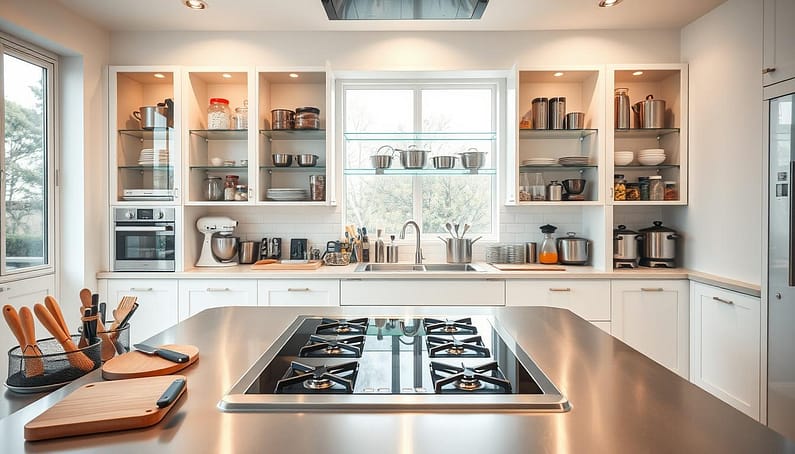
Your kitchen is like a messy democracy. Every gadget has a say, and clutter has a long-term lease. The rules are more like suggestions.
A professional kitchen is different. It’s a place of order and efficiency. Each tool has a specific role, and keeping things clean is a must.
This isn’t about making your kitchen a sterile place. It’s about making it better. We’re using the best ideas from top chefs to get great results.
Think of mise en place as a way of life. Imagine a kitchen that works like a well-oiled machine. Keep it clean like a surgeon’s room.
Why stick to amateur standards when you can have the best? This is your chance to go from a small kitchen to a top-notch one. For the best risotto you’ve ever had.
Essential Equipment & Tool Requirements
Building a pro-level kitchen isn’t about buying every shiny tool. It’s about choosing the best ones. I’ve seen many kitchens with too many gadgets. A true Home Kitchen Professional Setup means having tools that work well.
The chef’s knife is key. Most home sets have too many dull blades. A professional knife, like the Global chef’s knife, is sharp and efficient. It lets you control your ingredients, not just chop them.
This thinking applies to all your tools. Think in three main categories.
The Investment-Grade Workhorses
These are the core tools you buy once and use for years. A Le Creuset Dutch oven cooks evenly. An All-Clad pan heats well. A KitchenAid mixer makes everything from dough to meringue. These tools are more than purchases; they’re partners.
The Precision Instruments
Here, quality makes a big difference. A digital scale ensures accurate measurements. A Microplane grates garlic finely. OXO measuring cups and spoons are always right. A mandoline slices food perfectly. This level is about precision.
This is the heart of a modern, flexible Home Kitchen Professional Setup. Your kitchen should be versatile. A Breville immersion blender is great for soups. A quality rice cooker is easy to use. These tools are the portable chef tools that make your kitchen mobile.
To see how these tools fit together, look at this breakdown:
| Category | Iconic Examples | Core Function |
|---|---|---|
| Workhorses | Le Creuset Dutch Oven, All-Clad Pan, KitchenAid Mixer | Foundation cooking with unmatched durability and even heat. |
| Precision | Digital Scale, Microplane, Mandoline | Accuracy and consistency for flawless technical execution. |
| Portable Power | Breville Immersion Blender, Global Knife Set, Sheet Pans | Professional results in any location, the essence of mobile efficiency. |
What’s not included? Unitaskers like avocado slicers. A pro setup focuses on versatility. Your sheet pans can roast, bake, and rest meats. Your mixing bowls are for prep, storage, and serving.
Building this collection means every tool has a purpose. It turns cooking into a performance. And the best part? This setup doesn’t just improve your food. It changes how you think. You start to create, not just follow recipes.
Food Storage & Transportation Solutions
The difference between a home cook and a pro often reveals itself not at the stove, but in the silent, cold aftermath of the fridge.
You can execute a perfect sear or a flawless emulsion. But if you bury that effort in a warped takeout container, you’ve lost the battle. A Home Kitchen Professional Setup treats storage as the final, non-negotiable step of the recipe. It’s logistics. It’s preservation. It’s respect for your ingredients and your time.
Amateur storage is a tragedy of lost flavor. It creates food waste, muddled flavors, and what I call “fridge ghosts”—those unidentifiable, fuzzy leftovers that haunt your shelves. The professional mindset solves this with gear designed for the job.
Think Cambro. The industry standard for a reason. Your containers must be airtight and leak-proof to lock in moisture and lock out odors. They need to be durable enough to survive a drop and stackable to maximize space. Microwave-safe is non-negotiable for reheating. And clarity? That’s your secret weapon against waste. Seeing your food is half the battle.
| Container Type | Ideal For | Key Feature | Pro Tip |
|---|---|---|---|
| Rectangular Cambro-style | Broths, sauces, bulk ingredients | Space-efficient stacking | Use for “prep once, eat twice” proteins |
| Round Glass with Lids | Leftovers, marinating proteins, salads | Microwave & oven safe | Perfect for acid-based dressings that stain plastic |
| Screw-top Jars | Grains, nuts, chopped veggies, dressings | Superior seal, portion control | Label the lid, not the jar, for easy reuse |
| Insulated Transport Bags | Catering, meal delivery, picnics | Temperature control | Keep a dedicated bag with frozen gel packs ready |

Now, let’s talk systems. Chefs don’t rely on memory. They use painter’s tape and a Sharpie. Label everything: the dish and the date. This isn’t obsessive. It’s the bedrock of your food safety setup. It turns your fridge from a black hole into a searchable database.
The most critical step happens before the lid goes on. You must master the cool-down. Never seal piping-hot food. You’ll create a perfect, humid environment for bacteria to throw a rave. Let food reach room temperature quickly (spread it thin in a shallow container), then refrigerate.
Organize your fridge with the zoning precision of an urban planner. Top shelf for ready-to-eat items. Middle for dairy and proteins. Bottom for raw meats (in their own contained zone). Crisper drawers for produce. This isn’t just neat. It prevents cross-contamination and makes inventory a glance away.
Proper storage is the silent guardian of your Home Kitchen Professional Setup. It preserves flavor, texture, and your hard-earned effort. It turns your refrigerator into a curated library of delicious possibilities, not a graveyard of good intentions.
Sanitation Systems & Health Code Compliance
Sanitation is key in cooking, like a stagehand keeping the show running smoothly. It’s the behind-the-scenes work that keeps everything safe. In restaurants, it’s a must-follow rule. But in your Home Kitchen Professional Setup, it’s a game-changer. You’re not inviting health inspectors, but following their rules makes your kitchen professional.
Color-coded cutting boards are a simple yet smart idea. Red for beef, blue for fish, and green for veggies. It’s not just about keeping things organized. It’s a way to stop bacteria from spreading. This system is the first step in making your kitchen pro.
Having sanitizer nearby is another smart move. A bucket with bleach solution and a spray bottle with sanitizer are essentials. They should be easy to reach. This makes cleaning up quick and easy, a sign of a pro.
“Clean as you go” is a key habit. It’s about keeping your kitchen clean and safe. This habit stops messes from building up. It’s a skill that becomes second nature.
| Component | Purpose | Pro Tip |
|---|---|---|
| Color-Coded Cutting Boards (Set of 4) | Prevents cross-contamination between food groups. | Assign colors and stick to them religiously. No “just this once” exceptions. |
| Commercial Food-Safe Sanitizer Spray | Kills 99.9% of pathogens on surfaces in 60 seconds. | Mix or buy according to label specs. Test strips are a cheap, wise investment. |
| Dedicated Sanitizer Bucket & Cloths | Provides a ready-to-use station for tools and hands. | Use dark cloths for floors, light cloths for counters. Never mix them. |
| Instant-Read Thermometer | Ensures proteins are cooked to safe internal temperatures. | Calibrate it yearly. Your guess is not a data point. |
| Disposable Gloves & Hair Nets | Creates a physical barrier for handler and food safety. | Change gloves between tasks, specially after handling raw meat. |
https://www.youtube.com/watch?v=vln5rN9rqR8
When you start mobile cooking, your sanitation kit is your shield. It shows clients you’re serious about safety. Your kit should include sanitizer, cutting board sheets, a thermometer, and gloves. Treat it like your toolkit, because your reputation is on the line.
This isn’t about being scared. It’s about being confident. A strict Home Kitchen Professional Setup sanitation plan lets you focus on creativity. For mobile cooking pros, it’s what makes you a pro. It’s a promise of trust to your clients. And it feels great to be that ready.
Mobile Setup Strategies for Client Homes
When you bring your kit to a client’s home, you enter new territory. The Home Kitchen Professional Setup you’re used to will face its biggest challenge. You’ll find dull knives, a single wonky burner, and counter space that vanishes quickly.
Being strategic is key. Mobile cooking is not just about moving your gear. It’s about adapting to new situations. You need a well-packed travel kit, a plan for scouting, and the ability to pack smart but light.
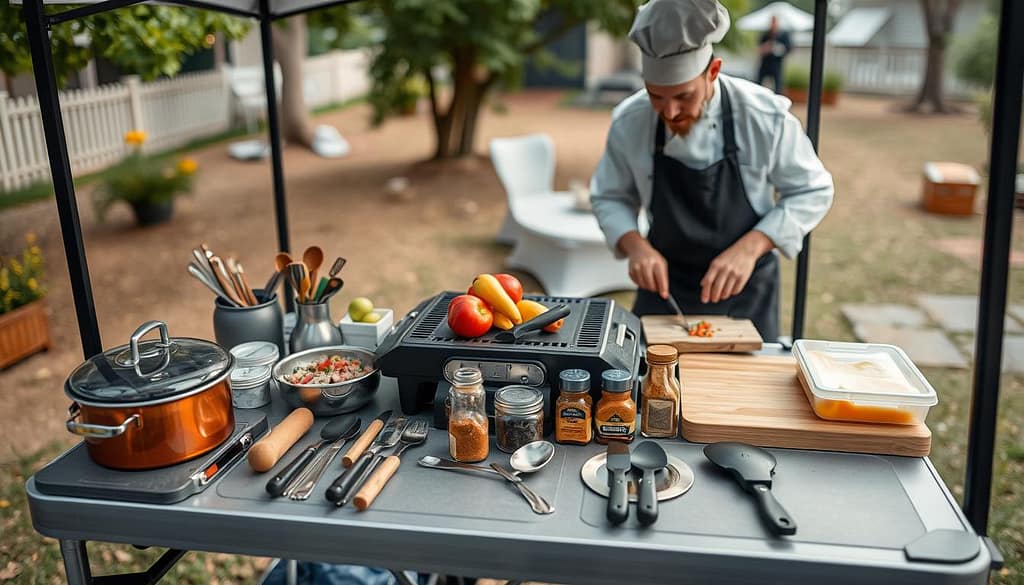
Your portable chef tools are essential. It’s not about bringing everything. You need your Global knife, favorite tongs, and a precise thermometer. These tools make any kitchen your temporary command center.
But tools need a solid base. A compact, high-wattage induction burner is vital for unpredictable stovetops. A foldable utility cart is more than storage. It’s your prep station and organizational hub, creating order in chaos.
The table below outlines the key components of a successful mobile strategy. It’s your pre-mission checklist.
| Strategy Component | Essential Items | Backup Plan | Pro Tip |
|---|---|---|---|
| Heat Sources | Portable induction burner, butane torch | Verify client stove type in advance; bring multiple fuel canisters | Induction offers precise control in any environment |
| Cutting & Prep | Chef’s knife, paring knife, cutting boards, peelers | Have a ceramic honing rod; assume all client knives are dull | Your own boards ensure sanitation and proper sizing |
| Work Surface & Org | Foldable utility cart, sheet pans, mise en place bowls | Use oven racks as extra shelving; counter space is often an illusion | The cart is your mobile kitchen island—claim your territory |
| Measurement & Control | Digital scale, thermometers, timers | Phone apps as backup; never trust analog oven dials | Precision tools eliminate the “variable” from client appliances |
Scouting the kitchen beforehand is a must. A quick photo or video walkthrough is invaluable. Note the oven type, burner count, outlet locations, and ventilation. Is there a working hood or just a sad window?
Ventilation is critical for mobile cooking. Have a backup plan. Portable induction burners produce less heat than gas. Strategic fan placement can improve airflow. Sometimes, the best strategy involves kitchen remodeling ideas for mobile homes that focus on temporary, efficient layouts.
Packing light is a philosophy. Every item must justify its space and weight. Does it serve multiple functions? Is it critical to the menu? Could you improvise with something already on-site? This curation makes your portable chef tools collection truly professional.
This approach turns you into a culinary special forces unit. You’re adaptable, self-contained, and ready for any mission. You don’t complain about the terrain—you adapt to it. You don’t fear the unknown kitchen; you conquer it with preparation and the right gear.
That’s the real power of a strategic Home Kitchen Professional Setup. It’s not confined by four walls. It’s a capability you can project anywhere, turning any space—no matter how humble or chaotic—into a stage for culinary excellence.
Cost Analysis & Equipment Investment ROI
Let’s be frank. Passion projects don’t cover the mortgage. Turning your cooking skills into a business means every dollar counts. Your Home Kitchen Professional Setup is a balance sheet, not a hobbyist’s wish list.
Think about that heavy-duty mixer or induction cooktop. It’s not just for your home. It’s a long-term partner. The ROI math is simple: these tools last decades, saving you money and time.
Superior output justifies premium pricing. Clients can tell the difference in quality. This allows you to charge what you’re truly worth.
Never underestimate the return on a robust food safety setup. Its ROI is in avoiding disasters—no lawsuits, no ruined reputations. It’s the cheapest insurance policy you’ll ever buy.
This final tally isn’t about being cheap. It’s about making a case for the tools that make your craft sustainable. Build the business case. Then go build your empire.