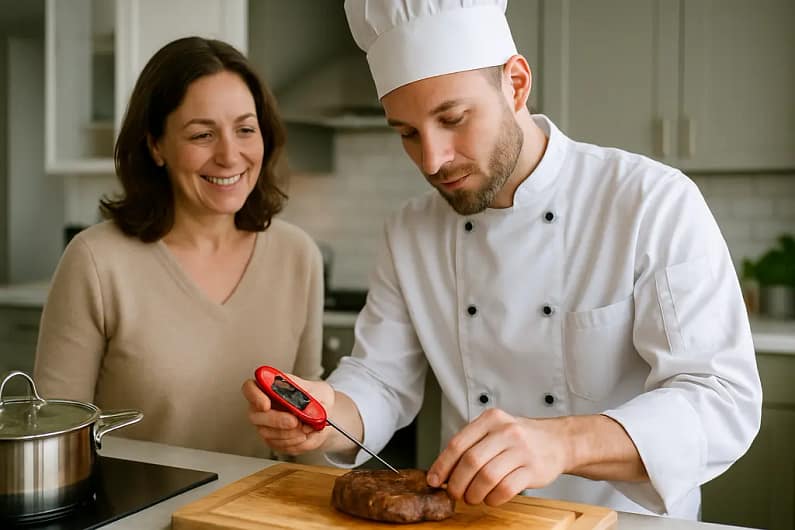
Hiring a chef to cook inside your home is both practical and personal, so private chef food safety should be part of the first booking conversation, not a detail left for the day of service. The risk context is real: the CDC estimates that 48 million people in the United States get sick from foodborne illness each year, with 128,000 hospitalizations and about 3,000 deaths, according to its food safety facts. That does not mean private dining is unsafe. It means clients and chefs benefit from direct, calm questions that set expectations before shopping, prep, travel, and service begin.
As a booking strategist, I see trust form fastest when clients ask specific questions and chefs answer without defensiveness. A polished menu matters, but so do cold storage, clean prep habits, allergen controls, written terms, and proof of experience. If you are comparing a restaurant meal, a catered dinner, or a chef-prepared service at home, remember that the service setting changes the risk controls. To better understand dining preferences in varied settings, you might explore Hudson Street Cafe, but remember that an in-home chef booking requires a tailored safety checklist because the chef might be transporting ingredients, using your kitchen, or finishing food outside a commercial setting.
Why Private Chef Food Safety Belongs In The Booking Conversation
Risk Context Without Panic
Foodborne illness can come from many points in the food chain, including purchasing, storage, preparation, holding, and service. A client does not need to become a health inspector, but asking well-formed questions is reasonable. A study of reported foodborne disease outbreaks from 1998 through 2013 found that about 56% involved food prepared in restaurants, while private homes accounted for about 20%, as reported in this restaurant-associated outbreak study. The useful takeaway for home dining is not that one setting is always safer than another; it is that food preparation setting, scale, and controls all matter.
In a private home, the client may not see the chef’s supplier list, prep site, cooler setup, or sanitation routine unless those topics are raised during booking. A strong chef should be ready to explain how food is purchased, transported, stored, prepared, served, and cleared. If the chef seems irritated by basic safety questions, that is information you can use before paying a deposit.
Private Chef Food Safety Questions Clients Should Ask Early
Treat private chef food safety as part of fit, just like cuisine style, price, and schedule. Good questions are not accusations. They are a shared plan for keeping the event organized and respectful of the household. Ask them during the consultation, then have the key points reflected in the written agreement or event notes.
- Do you hold a current food safety certification or local equivalent, and can you provide a copy?
- Where will food be prepared: in my home, in a licensed kitchen, or partly off-site?
- How will you keep cold foods cold and hot foods hot during transport and service?
- How do you separate raw meat, seafood, poultry, produce, and ready-to-eat foods?
- What is your process for severe allergies or dietary restrictions?
- Do you bring your own clean utensils, cutting boards, towels, aprons, and sanitizer?
- Have you handled events of similar size, menu style, or service format?
- Can you provide recent references and written booking terms?
Credentials And Safety Systems To Ask About
Certification Is A Starting Point
A food safety certificate does not guarantee perfect behavior, but it shows that the chef has received formal training and understands recognized safety concepts. Ask for the certificate name, issuing organization, expiration date, and whether local rules require anything more for the type of service you are booking. Requirements vary by jurisdiction, so a chef working across city, county, or state lines should be clear about where they are permitted to operate.
For clients, the practical question is simple: “Can you show me your current documentation?” For chefs, this is a chance to build confidence. Keep a digital copy ready, include renewal dates in your booking files, and do not make clients chase for proof. This is one of the easiest ways to show professionalism before menu planning begins.
Experience Should Match The Event
Restaurant experience, catering experience, and private home service overlap, but they are not identical. A chef who has worked a busy line may be highly skilled under pressure, while a chef who regularly serves family dinners may be stronger at household flow, storage limits, and client communication. Ask which environments the chef has worked in and whether they have managed an event like yours.
Scale matters. Cooking a plated anniversary dinner for two is different from serving a buffet for twenty guests. A seafood-heavy menu brings different handling needs than a vegetarian brunch. A meal for children, older adults, pregnant guests, or people with medical dietary restrictions may require more careful communication, although the chef should not be giving medical advice unless qualified to do so. If a booking involves pregnancy-related preferences, these prenatal chef service questions can help clients frame the conversation without turning the consultation into a medical appointment.
Allergens, Sourcing, And Service-Day Handling
Allergen Plans Need Detail
Allergen management is one of the clearest trust tests in a private chef booking. “We can handle that” is not enough for a serious allergy. Ask how ingredients are checked, how substitutions are documented, whether the chef uses separate utensils or cookware, and how cross-contact is reduced during prep. The chef should also ask you for specifics, including whether the concern is a preference, intolerance, allergy, or severe allergy requiring stricter controls.
Clients should avoid assuming that a chef can make any kitchen risk-free. Home kitchens often contain shared appliances, porous cutting boards, opened pantry items, and equipment used for many foods. The right conversation identifies what can be controlled and where uncertainty remains. If the risk is too high for the household, the responsible answer may be to simplify the menu, use sealed ingredients, bring dedicated tools, or decline a dish that cannot be prepared safely enough.
Transit And On-Site Habits Are Visible
Private chef food safety does not end with the menu proposal. On service day, clients can observe whether the chef arrives organized, keeps raw and ready-to-eat items apart, washes hands at sensible points, maintains clean work areas, and avoids leaving perishable foods out for long stretches. You do not need to hover, but you can agree in advance where food will be stored, which refrigerator space is available, and whether the chef needs access to ice, outlets, trash bags, or extra counter space.
Ask how the chef handles leftovers as well. Will food be cooled, packed, labeled, and placed in the refrigerator before the chef leaves, or is cleanup limited to dishes and counters? Written leftover expectations protect both sides. They also prevent the awkward end-of-night moment when guests are tired and no one is sure what should be saved or discarded.
References, Insurance, And Written Terms
Professional Paperwork Protects The Relationship
A reliable private chef should be able to explain business basics without making the process feel cold. Ask whether the chef operates as a registered business, provides invoices, uses written agreements, and has cancellation, refund, and rescheduling terms. If insurance is part of your decision, ask what type of coverage the chef carries and whether they can provide proof. Do not rely on a social media profile as a substitute for business terms.
References are also useful, especially for higher-cost bookings or meals involving special dietary needs. Ask for recent references from clients with similar events if available. A chef may need to protect client privacy, so accept reasonable boundaries, but there should still be a way to verify experience through references, a professional portfolio, or documented event history.
How Chefs Can Answer With Confidence
For chefs, these questions are not obstacles. They are part of client management. Prepare a short safety and service document that explains certifications, sourcing habits, allergen questions, transport methods, setup needs, service timing, and cleanup scope. Send it after the consultation with the proposal. That one document can reduce repeated emails and make the booking feel steadier for the client.
A chef who communicates well before the deposit is usually easier to work with during the event. Fast answers are helpful, but clear answers are better. If a client asks something outside the chef’s knowledge, the chef should say so and explain how they will confirm the answer. Guessing is weaker than honesty.
Private Chef Food Safety In The Booking Decision
The best private chef food safety conversation is direct, polite, and specific. Clients should ask for proof of training, clarity on food handling, allergen procedures, references, insurance, and written terms. Chefs should answer those questions as part of the service, not as an interruption to creativity. Trust grows when both sides know what will happen before groceries are purchased and before the chef steps into the kitchen.
If two chefs offer similar menus and pricing, choose the one who gives clearer answers about safety and service flow. A beautiful dinner is easier to enjoy when the client knows who is responsible for ingredients, timing, storage, cleanup, and follow-up. That kind of planning does not take the warmth out of private dining. It gives the meal a steadier foundation.