
Most personal chefs would prefer to julienne a hundred shallots than deal with spreadsheets. But, in today’s world, the price of eggs is as high as a streaming service no one uses. Recipe costing is more than just numbers; it’s about dealing with trim waste and the mysterious shrinkage in your walk-in.
I learned this the hard way at a dinner party in Marin County. My “intuitive” pricing left me earning less than minimum wage, thanks to a generous use of black truffle. The COGS formula—Beginning Inventory plus Purchased Inventory minus Ending Inventory—is key to financial freedom.
Shetice Jackson, the Food Cost Queen, suggests aiming for a 30 percent food cost. This is the line between making money and working for free. Yield tests, though not glamorous, are essential. They help you understand the true cost of ingredients, like a whole salmon.
Sourcing Map: Premium Allergen-Safe Items, Specialty Grocers, Farmers Markets, and Bulk Buying
Every ingredient has a story, and it’s up to you to find it. Finding allergen-safe ingredients is like a culinary hunt. It’s about more than just shopping; it’s about connecting with your local food world.
Farmers markets offer unique items, like heirloom carrots. But, they can be tricky. They might not always fit your plans, leading to unexpected challenges.
Specialty stores like Whole Foods and local co-ops have safe items. These are key to avoiding food allergies. But, how do you balance quality with price?
Buying in bulk can save money. Yet, you must think about yield loss. For example, fifty-pound sacks of potatoes might sprout in your garage. Allergen-safe shopping is not just right; it’s smart business.
When a client mentions a nut allergy, and you can name a trusted supplier, you’ve earned your premium price. Specialty items often have less waste, making them worth the extra cost.
| Item | Source Type | Price Range | Yield Loss (%) |
|---|---|---|---|
| Heirloom Carrots | Farmers Market | $3-$5/lb | 10-15% |
| Organic Quinoa | Specialty Grocer | $4-$6/lb | 5-10% |
| Bulk Potatoes | Restaurant Supply | $0.50-$1/lb | 20-30% |
Do the math before buying in bulk. Your sourcing map is a strategic plan, not just a shopping list. It can make or break your menu costs.
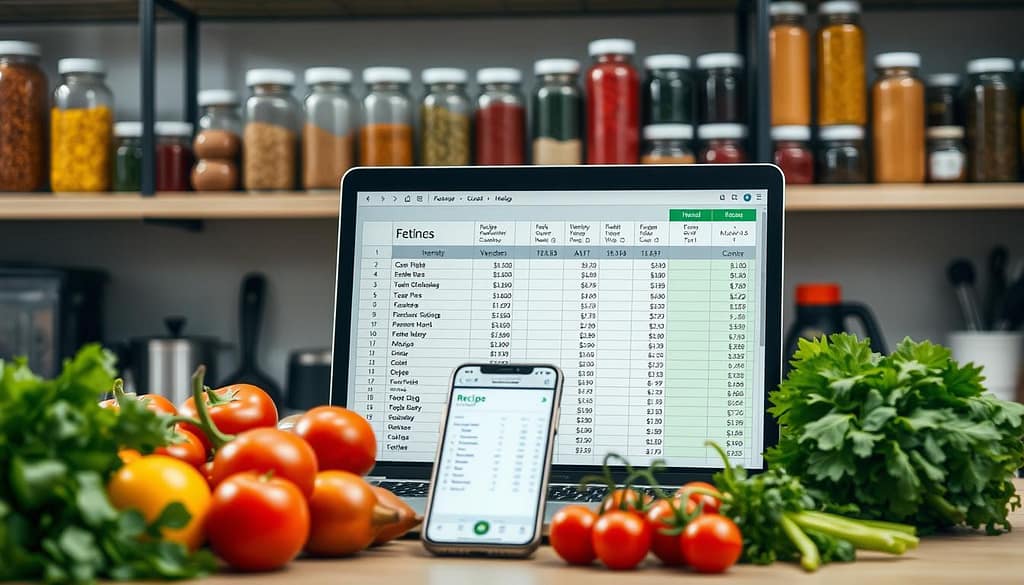
Spreadsheet or App Build: Items, Vendors, Units, EP Cost, and Live Links
The debate between spreadsheets and apps for recipe costing is as heated as a chef’s kitchen on a Friday night. Each method has its loyalists, but the real question is: which one keeps you from drowning in a sea of numbers at 11 PM after a brutal service?
Building a functional costing matrix is not just a luxury; it’s a necessity. Start by listing every item you purchase. Include the vendor who supplies it, the unit of measurement, and—most importantly—the Edible Portion (EP) cost after trim and waste. This is where recipe costing transforms from an abstract concept into operational reality.
Live links to vendor pricing pages are the unsung heroes of this system. Imagine the chaos when the price of olive oil spikes due to a drought in Spain, and you only discover it three months later. By that time, your profit margin has evaporated faster than a chef’s hopes for a Michelin star. With real-time updates, you can adjust your costs immediately, keeping your financial health intact.
Whether you choose an app like MarginEdge or stick with a simple Google Sheets template, the non-negotiable feature is the EP cost column. Without it, you’re pricing based on what you bought, not what you actually serve. And that, my friend, is how you slowly go broke while looking busy.
| Item | Vendor | Unit | EP Cost | Live Link |
|---|---|---|---|---|
| Olive Oil | Gourmet Grocer | Liter | $8.00 | Link |
| Eggs | Local Farm | Dozen | $3.50 | Link |
| Chicken Breast | Butcher Shop | Pound | $5.00 | Link |
Target Ranges: COGS 25–40% by Service Type — Meal Prep vs. Dinner Party vs. Tasting Menu
Understanding COGS is more than just numbers; it’s a delicate art. For personal chefs, the food cost percentage changes with the service type. Let’s explore the differences.
Profitable restaurants aim for a food cost between 28% and 35%. This is found by dividing food costs by sales. But, comparing this to your actual costs shows where you need to improve.
Meal prep services can keep costs between 25% to 28%. This is because the volume is steady, and the menu is simple. You can control costs better with this setup.
Dinner parties, with their custom menus, are a bit more unpredictable. They usually cost between 30% to 35%. This is okay, as long as you’ve priced your services correctly. A dinner party with Wagyu and truffles will cost more than a meal prep service with chicken and veggies.
Tasting menus, with their elaborate dishes, can reach up to 40% COGS. The high ticket price makes this cost acceptable. The key is to know your ideal food cost for each service type and compare it to your actual costs.
To see these ranges clearly, check out the table below:
| Service Type | Ideal COGS Range | Typical Food Cost % |
|---|---|---|
| Meal Prep | 25% – 28% | Predictable |
| Dinner Party | 30% – 35% | Custom Menus |
| Tasting Menu | Up to 40% | High Perceived Value |
The problem isn’t the percentage itself; it’s not knowing it. So, balance your creativity with smart recipe costing. This will lead you to success in the kitchen!
Substitutions Matrix for Price Spikes: Eggs, Dairy, Olive Oil, and Proteins
Food prices can change quickly, like a celebrity’s marriage. Having a substitutions matrix is key. It helps you deal with price spikes easily. Imagine needing to find a substitute for eggs in the dairy aisle. Your matrix will guide you.
When eggs get expensive, try flax eggs for baking or silken tofu for custards. You might change your menu to egg-free dishes until prices drop. It’s about being flexible, not sacrificing quality.
Dairy prices up? Try cultured cashew creams. Many Mediterranean dishes don’t need butter. With olive oil prices changing, have a list of substitutes. Use avocado oil for high-heat cooking or grapeseed oil for a neutral taste. Cutting down on oil and using technique can also help.
Beef prices high? Your matrix should suggest lamb, pork shoulder, or plant-based options. This keeps your menu appealing and your costs down. It’s about being smart with your menu.
| Ingredient | Substitution | Notes |
|---|---|---|
| Eggs | Flax Eggs | Great for baking; mix 1 tbsp flaxseed meal with 2.5 tbsp water. |
| Dairy | Cultured Cashew Cream | Rich and creamy; perfect for sauces and desserts. |
| Olive Oil | Avocado Oil | High smoke point; ideal for frying and sautéing. |
| Beef | Lamb | Similar flavor profile; often available at a better price. |

With this substitutions matrix, you’re ready for any price spike. Flexibility is key in a world where supply chains are unpredictable. Stay ahead, and your food cost % will be happy!
Portion Control Tools: Scoops, Ladles, Standard Pans, and Kid Portions
Portion control tools are key in a successful kitchen. If plates come back half full, it’s time to adjust. Cooking should fill plates, not leave food untouched.
It’s not about being cheap; it’s about finding the right balance. Standard scoops and ladles help keep portions consistent. They prevent over- or under-serving, which is good for both customers and your wallet.

Don’t forget about kid portions! Serving a four-year-old a big steak is not smart. Kids like simple foods, so smaller portions save money and please them.
Inflation updates can affect your menu. As prices go up, old portion sizes might cost you more. Watch for uneaten food to see if you need to adjust.
By monitoring how dishes are returned, you can tweak your menu. Look at untouched sides and think about changing them. It’s about feeding clients well and keeping your business healthy.
For more on pricing and profit, see our personal chef pricing guide.
Waste Log and Repurpose Chart: Soups, Stocks, and Snacks
In cooking, waste is a treasure waiting to be found. The waste log is like a kitchen confessional. It shows us the truth about our ingredients.
Tracking these elements is not obsessive. It’s about making ingredients work for us, not the other way around. Each entry in your waste log turns waste into a valuable resource.
The repurpose chart combines creativity with practicality. Vegetable trimmings become rich, roasted-vegetable stocks. These stocks make your dishes better.
Parmesan rinds can turn into a hearty minestrone. Day-old bread becomes croutons, breadcrumbs, or a warm bread pudding. This is not just reducing waste; it’s creating new dishes.
Snacks can also use trim waste. Imagine a crostini with herb stems turned into pesto. This is culinary innovation.
By tracking yield loss, you create a closed-loop system. This reduces waste and improves your menu. It’s a win-win that would make any environmental economist happy.
Price Updates: Weekly Routine for Flyers, Loyalty Cards, and Vendor Alerts
Every Thursday morning, I start my week with a critical task. I scan grocery flyers for price changes, like a trader watching the market. This task is key to staying ahead in cooking.
Digital flyers from big chains like Kroger and Safeway are free and full of useful info. Ignoring them is like not reading the opponent’s playbook. Loyalty cards help when buying lots of items. For example, saving $0.40 per pound on chicken thighs can add up fast.
Vendor alerts from suppliers like Sysco or US Foods warn me of price changes. Setting up Google Alerts for terms like “egg prices 2025” gives me a big picture view. This helps me adjust prices before they’re too late.
Keeping an eye on allergen-safe sourcing is also key. If my gluten-free flour supplier raises prices, I catch it early. Inflation updates affect my business directly. If quinoa goes up 15%, I need to change my prices before the month ends.
| Item | Old Price | New Price | Price Change (%) |
|---|---|---|---|
| Chicken Thighs | $3.50/lb | $3.90/lb | 11.43% |
| Gluten-Free Flour | $4.00/lb | $4.50/lb | 12.50% |
| Quinoa | $2.50/lb | $2.88/lb | 15.20% |
By keeping up with price changes, I can manage ingredient costs better. This routine helps me save money and keep my dishes profitable and appealing to clients.
Family Communication About Swaps and Value Protection
Imagine you’re at dinner, and everyone wants their usual ribeye. But the budget doesn’t allow it. It’s a hard talk, one no cooking school prepares you for. How do you tell them about the change without making excuses?
Talking about ingredient swaps is like a diplomatic mission. You need to be a teacher, a counselor, and an economist. When prices go up, explain the reasons clearly. Say, “The high cost of eggs is also affecting our meat prices. So, we’re trying this amazing braised lamb shoulder.”
This way, you turn a possible loss into a gain. You show that you’re protecting their value. People don’t worry about your costs; they want a great experience for their money.
By talking about swaps early and with passion, you’re not just saving money. You’re showing your skills. Families that understand your choices are more supportive. And they’re less likely to complain when prices go up.
Downloadable Calculator and SOP: Your Menu Costing Command Center
After exploring yield tests, substitution matrices, and waste logs, you might feel lost. Don’t worry. You don’t need an MBA to understand it. What you need is a simple calculator and a Standard Operating Procedure (SOP) that makes things easy, like your morning coffee.
The downloadable calculator makes recipe costing easy. It’s free because I want to help chefs succeed, not just get by. This tool handles COGS formulas, EP cost calculations, and food cost percentage comparisons all in one spot. Just enter your data, and it gives you clear results, like a business consultant would.
The SOP guides you through a simple weekly routine. Start with an inventory count on Monday, check vendor prices on Tuesday, adjust menus on Wednesday, and talk to clients on Thursday. It’s not exciting, but it keeps your recipe costing right, food cost percentage in check, and yield loss from hurting your profits.
See this calculator and SOP as your business’s sous chef. They do the hard work, so you can focus on the cooking that made you a chef. Download it, make it your own, and use it to make your business better.